Review · Policy News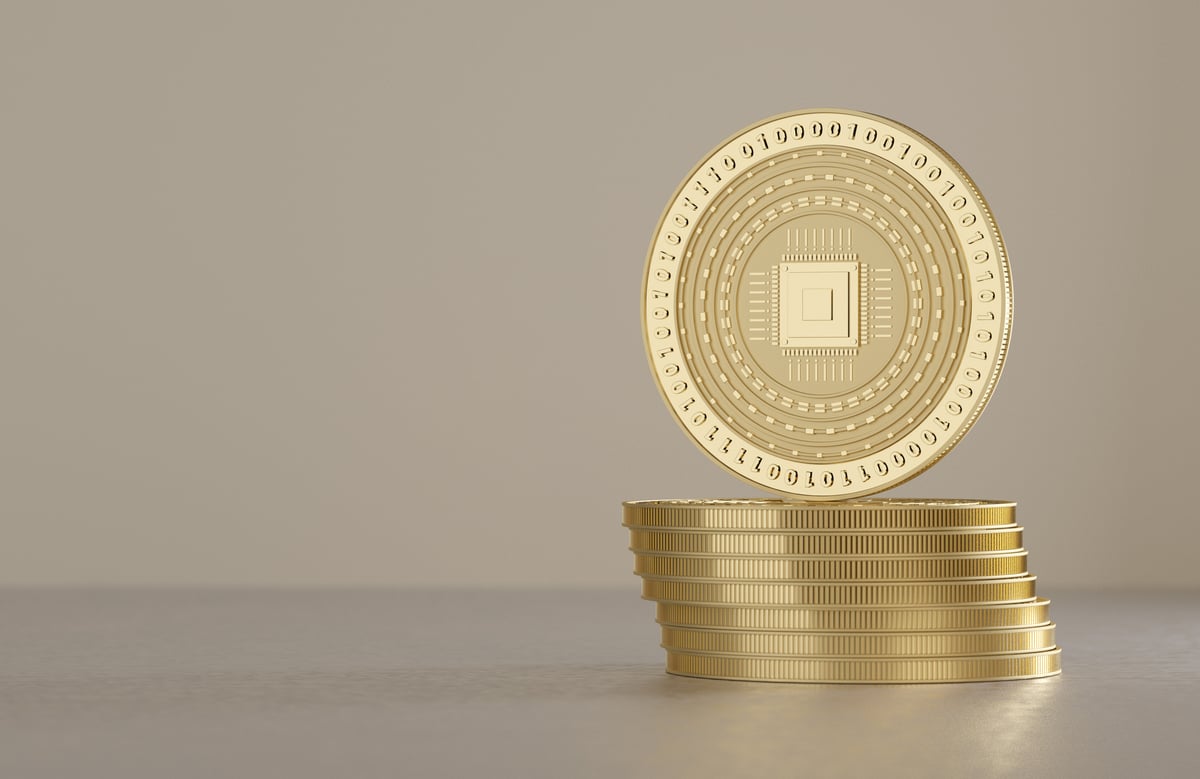
Commodity Futures Trading Commission (CFTC) Chairman Michael Selig said on Sept. 22 that regulators (and thus investors) must prepare for "mass tokenization" of assets, and he went on to conjecture that tokenization and the 24/7 trading it enables will reshape markets at a pace faster than any other such changes over the prior decades. He probably isn't wrong; the consultancy McKinsey is expecting as a base case that the sum of tokenized assets will be worth $1.9 trillion by 2030, up from $38.6 billion of tradable assets today. Tokenization is the process of representing the ownership information of an asset, such as a stock, as a digital token managed on a blockchain.
So what's the best way to get ahead of the trend and get some upside? Image source: Getty Images. It won't work to buy tokenized assets directly Some investors might be inclined to simply buy tokenized assets, such as tokenized stocks, to gain exposure to the growth of tokenization.
That won't work, just like buying food wrapped in plastic doesn't enable a buyer to benefit from rising sales of food-safe plastic wrap. The value created by tokenization is most commonly captured by the services that charge for handling the tokenization process itself and by the blockchain networks on which the tokenized assets are held and traded. Every time a tokenized asset changes hands, the network it's parked on captures some transaction fees.
In some cases, those fees are routed in ways that benefit the price of the network's native token, and when that happens, the frequency of tokenized asset trading is directly linked to the scale of the benefit to the token's price. Solana ( SOL -0.56% ) , for example, is a leading network in stock tokenization, with $491.1 million in tokenized stocks on its chain as of Sept. 25. Because it's a fast and inexpensive chain, it's a good fit for assets like stocks, which tend to be swapped fairly often (at least by the institutional investors who command most of the capital).
So, it could be a good fit for an investment thesis centered on tokenization. Today's Change ( -0.56 %) $ -0.68 Current Price $ 121.00 But it's far from perfect. At present, Solana permanently destroys only half of each base fee it charges to users.
A recent proposal by its developers estimated that Solana destroys approximately 648 SOL daily as a result of its on-chain activity, while also issuing roughly 60,000 SOL of new supply to pay the network's validators. That could change in the future, but recent proposals have attempted to address the issue directly, only to be rebuffed in governance votes. So what's the best way to invest in tokenization?
The best tokenization play that's currently available might not be a cryptocurrency at all. Robinhood Markets ( HOOD -1.18% ) just launched its new blockchain, the Robinhood Chain, intended primarily as a vehicle for trading tokenized stocks. The company that issues the stock captures the fee revenue from its chain directly, and because it's offered to investors as a share of stock and not as a cryptocurrency, there's a clear link between owning a share and owning a slice of the economic upside from its business activities, including those related to tokenized assets.
Premium Feature Moneyball Superscore 81 /100 Today's Change ( -1.18 %) $ -1.42 Current Price $ 119.40 But Robinhood's network is new, having only launched this summer. Its chain fees were $35.2 million for the first 25 days of September alone, up from $6.7 million for all of August. Going for a full quarter at that pace, if it's possible to do so, would generate a decently sized slice of Robinhood's $1.3 billion revenue in Q2, so there's definitely enough activity happening to stimulate some upside for those who buy the stock now.
It's also possible to get even more direct exposure to tokenization via crypto launchpad projects. But the risks involved are much higher. One illustrative example is Pons ( PONS -1.69% ) , Robinhood Chain's biggest meme coin launchpad, which lets creators pair new meme coins with tokenized stocks.
It also launched this summer, and it spends most of its revenue buying back and destroying its own token. Today's Change ( -1.69 %) $ -0.01 Current Price $ 0.64 It saw $31.5 million in fees for August. But its revenue has proven highly variable, ebbing and flowing with the speculative mood among crypto investors, and it's unclear if it has a long-term investment thesis.
As other crypto projects demonstrate they're generating good returns by providing tokenization as a service or by serving as a venue for trading tokenized assets, it'll be worth seeing whether they're sustainable enough to warrant investment. For now, the best approach here is to own Robinhood or Solana.
Source: The Motley Fool